
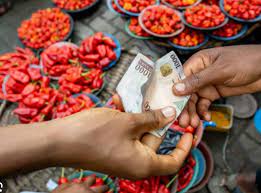
Indicators from the National Bureau of Statistics (NBS) reveal a notable reversal Economic Trends Signal in household consumption expenditure trends in Nigeria. After a consistent decline since Q2’22, expenditure saw an uptick in Q2’23, growing by 3.3%. However, concerns linger as inflationary pressures continue to impact spending habits.
According to the NBS, the last positive growth in household consumption expenditure was recorded in Q1’22, rising by 8.66%. Subsequently, Q2’22 witnessed a decline to -5.21%, followed by a further decrease to -5.83% in Q3’22. The trend intensified in Q4’22, plummeting to -12.47%, and Q1’23 saw a substantial contraction by -24.95%.
The NBS report, titled ‘Nigerian Gross Domestic Product (Expenditure and Income Approach) Report for Q1 and Q2 2023,’ attributes the recent shift to a 3.3% YoY growth in Q2’23. The report notes a positive quarter-on-quarter change, with a 20.29% decline in Q1’23 followed by an 11.68% rise in Q2’23.
Analysts attribute this reversal to Economic Trends Signal rising inflation, prompting households to allocate more funds to essential needs like food, while saving, investment, and capital expenditures take a backseat. Economic experts express concern that failure to address inflation swiftly may pose risks to capital formation and overall economic growth in the medium term.
Various professionals weigh in on the situation, with Marvellous Adiele of Parthian Partners linking the growth in household expenditure to inflation-driven increased spending on living expenses. Olatunde Amolegbe, the past president of the Chartered Institute of Stockbrokers, emphasizes the impact of galloping inflation on diverting income toward recurrent expenditure.

Furthermore, Tajudeen Olayinka of Wyoming Capital and Partners notes the improvement as a modest recovery but underscores the need for more efforts to push household consumption into positive territory.
The report also highlights the positive trajectory of GDP by expenditure, growing by 2.31% in real terms in Q1’23 and 2.51% in Q2’23. However, the Labour Party criticizes the APC-led Federal Government, attributing rising food prices and economic downturn to lack of planning and empathy.
While the government expresses commitment to poverty reduction, critics, including Atiku Abubakar’s aide, Mr. Phrank Shaibu, contend that the report reflects the worsening economic conditions for Nigerians. Concerns are raised over the Supplementary budget’s allocation for non-essential expenses while essential sectors like healthcare and infrastructure lack substantial funding, exacerbating the economic challenges faced by the populace.
For more news visit https://arritoneconsult.com.ng/blog
For more educational post visit examhood.com.ng