
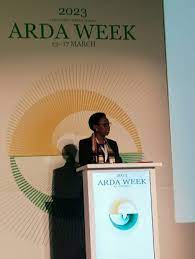
The African Refiners Pledge Single Grade has taken a significant step towards addressing the diverse grades of petroleum products across Africa and their associated health implications. ARDA has committed to achieving a unified grade of Premium Motor Spirit (PMS), commonly known as petrol, by the year 2030.
Mr. Anibor Kragha, the Executive Secretary of ARDA, African Refiners Pledge Single made this announcement during the CEO Strategic Session at the 24th World Petroleum Congress in Calgary, Canada, which concluded last week. He revealed that ARDA is collaborating with the African Union to advocate for the adoption of harmonized, pan-African clean fuel specifications, specifically the Afri 6 or 10 parts per million (ppm) specification for fuel quality standards throughout Africa.
Kragha explained the pressing need for standardization, highlighting the existence of 11 different grades of diesel or gas oil engines and 12 different grades of gasoline across Africa, with varying levels of pollutants. The initiative’s objective is to establish a single 10 ppm grade for fuel quality standards by 2030 across the continent.
One of ARDA’s primary goals is to promote investments throughout the entire downstream value chain. Kragha emphasized that while Africa is not directly involved in the Russia-Ukraine crisis, the continent’s focus is on ensuring energy security by maximizing African crude oil in African refineries and distributing cleaner fuels across the continent through integrated storage and distribution infrastructure.
To prevent a potential health crisis, Kragha stressed the importance of introducing cleaner fuels such as Liquefied Petroleum Gas (LPG) for cooking. He expressed optimism about the future of refining in Africa, pointing out the continent’s potential to meet its growing petroleum product demand with cleaner fuels.
Africa’s limited refining capacity has strained its foreign exchange reserves due to significant petroleum product imports. ARDA is actively supporting increased investments in refining capacity across the continent to address this issue. Kragha cited examples such as Angola’s efforts to expand its refining capacity and initiatives like NNPC Limited’s refinery revamp projects and the Dangote refinery in Nigeria, as well as projects by other ARDA members in different African countries.
Kragha highlighted the promising prospects for Africa’s refining and petrochemicals sector in the coming decades, driven by increased energy demand and population growth. He emphasized Africa’s relatively small contribution to global CO2 emissions, underscoring the continent’s need for a just and equitable downstream energy transition plan, prioritizing cleaner transport and cooking fuels in the short term and cost-effective renewables in the long term.
ARDA is actively developing a decade-by-decade African Downstream Energy Transition Plan, spanning from 2030 to 2050, along with a corresponding finance plan. This initiative aims to cater to Africa’s specific energy requirements while maintaining a balance between energy security and environmental sustainability.
For more news visit https://arritoneconsult.com.ng/blog
For more educational post visit examhood.com.ng